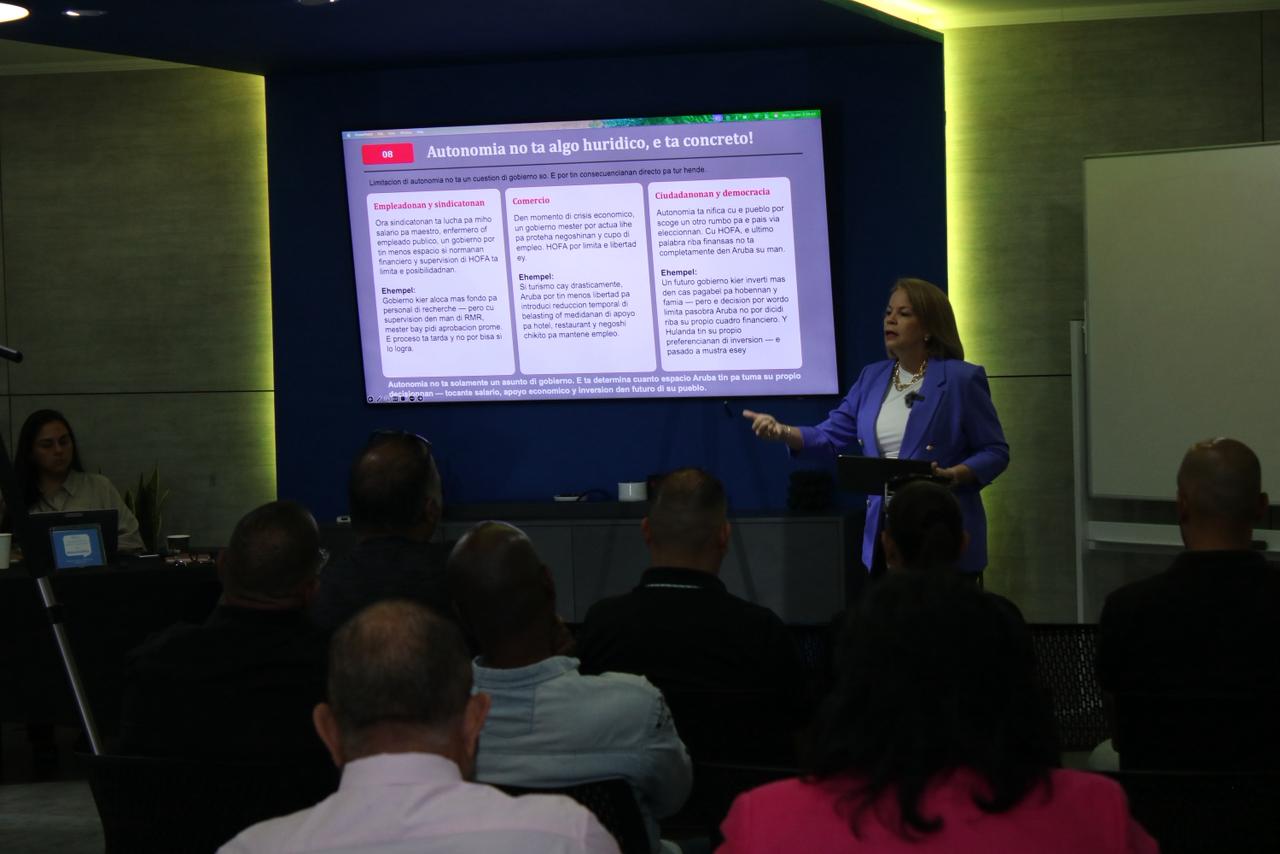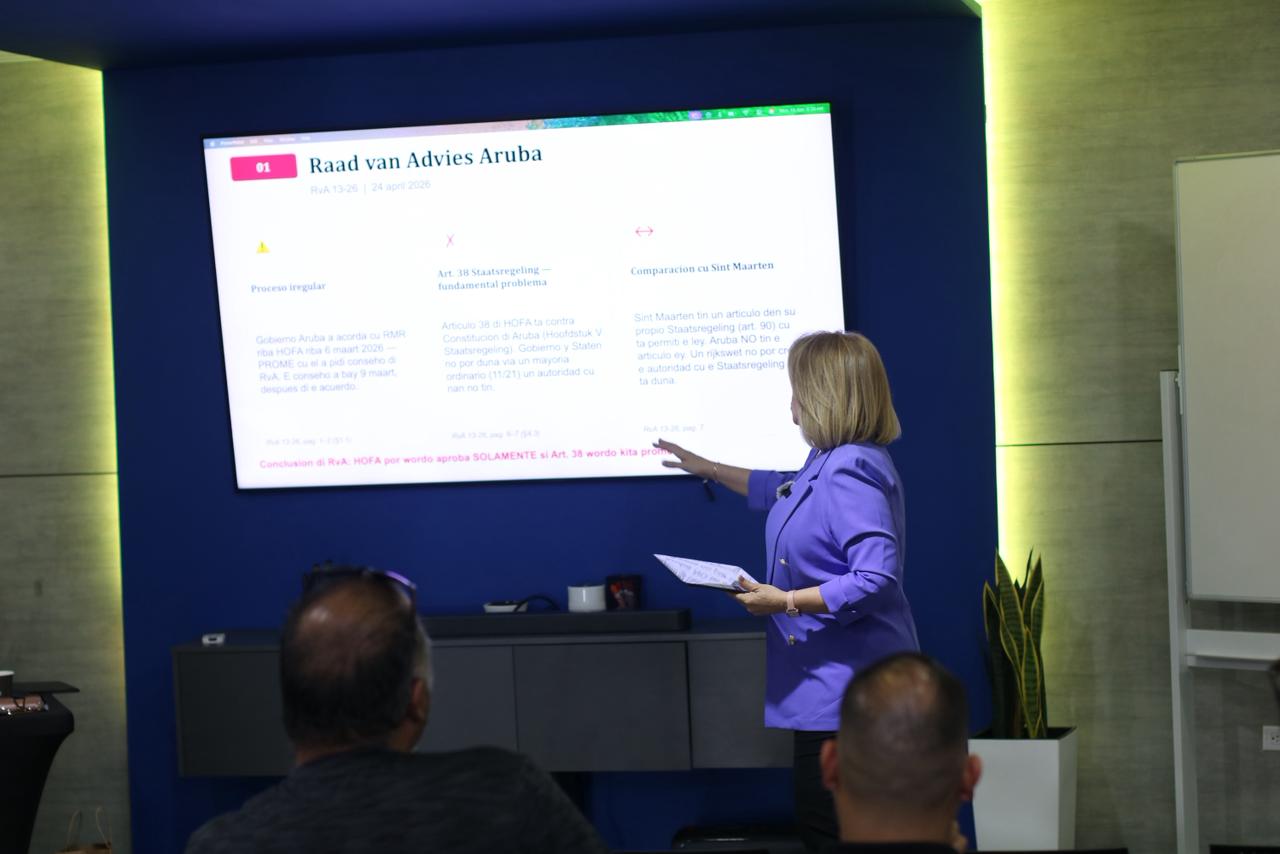
In the ATIA conference room, representatives of Aruba’s labor unions and commercial sectors met with the Leader of the MEP Faction, Mrs. Evelyn Wever-Croes, for a profound analysis of the advices issued by the Advisory Council of Aruba (Raad van Advies) and the Council of State of the Kingdom (Raad van State) regarding the proposed HOFA Kingdom Law and the National Ordinance on Safeguarding Sustainable Public Finances (LWHO).
A presentation based on concrete facts: What is the real question?
Wever-Croes defined the faction’s stance: “We agree with financial supervision; it is necessary. But the real question is: Why do we need to use a Kingdom Law (Rijkswet) as an instrument if we already have a local law (LAft) that has proven to work?”
The two supreme advisory bodies agree with the MEP Faction:
Advisory Council (RvA): Warned that the process was irregular because the law was agreed upon with the Netherlands before their advice was requested. Furthermore, Article 38 of HOFA violates the Constitution of Aruba. The RvA concluded that HOFA can only be approved if Article 38 is removed from the law.
Council of State of the Kingdom (RvS): Recognized that the goal of supervision is legitimate, but made serious warnings regarding central aspects that remain unanswered. Aruba CANNOT exit the supervision on its own (Art. 42); the exit is in the hands of the Kingdom Council of Ministers (Rijksministerraad). There is no clarity on which exact debt the Netherlands will refinance, and the PPP (Public-Private Partnership) debt is not included in the “schuldquote” (debt ratio), which must be quantified first. The RvS advises making all these changes before sending the law to Parliament.
The reality: What is really behind HOFA?
Mrs. Wever-Croes debunked the alleged advantages of the HOFA Kingdom Law, demonstrating that reality shows a very different picture:
Achievements under local law (LAft): Aruba is structurally complying with budgetary norms year after year. The reality is that Aruba managed to lower the Debt-to-GDP ratio to 61% by the end of March 2026 (the lowest figure since 2011), with a forecast of 48% for 2028. Our country’s rating is based on these concrete achievements and our track record, not on a future law; the Kingdom Law is simply a condition of the COVID loan and not a punishment for non-compliance.
The trap: If the HOFA Kingdom Law is accepted, Aruba will receive a lower interest rate on the COVID loan, which could represent savings of around Afl. 300 million over 20 years. However, this money will be deposited into an investment fund tied with chains. Those strict conditions exclude urgent projects that our people need right now.
HOFA does not combat corruption: HOFA is a budgetary norm law and NOT an anti-corruption law. To combat corruption, Aruba has its own strong and independent institutions, such as the General Audit Chamber (Algemene Rekenkamer), the Public Prosecutor’s Office (Openbaar Ministerie), the Public Procurement Office, the Integrity Bureau of Aruba (BIA), and the Ombudsman. The example of Curaçao and Sint Maarten confirms that, after 16 years under a Kingdom Law, integrity challenges remain; the Kingdom Law did not resolve them.
Conclusion
To conclude the meeting, Mrs. Wever-Croes and the MEP Faction reaffirmed that the process for HOFA is not over. The official proposal is for the governments to negotiate the changes recommended by the advisory bodies, without leaving the table, in order to convince the Netherlands that a Kingdom Law is not necessary. It has been proven that our local law (LAft) provides the same guarantees without giving The Hague the final word over our finances. Instead, MEP proposes a real alternative: a reinforced national ordinance or a mutual agreement (onderlinge regeling) that guarantees effective supervision without surrendering our constitutional rights.
The MEP Faction formally thanks the active attendance and participation of the representatives from the labor and commercial sectors, who highlighted the democratic value of having direct access to legal and financial analyses during these times.
“Aruba has already proven that financial discipline is possible under its own law. The figures are clear: 61% debt-to-GDP, surplus, and a forecast of 48% for 2028—all achieved under LAft, without a Kingdom Law. What we are asking for is simple: let’s reinforce the law that is proven to work, and let the final word on our finances remain in Aruba,” Evelyn Wever-Croes concluded.