

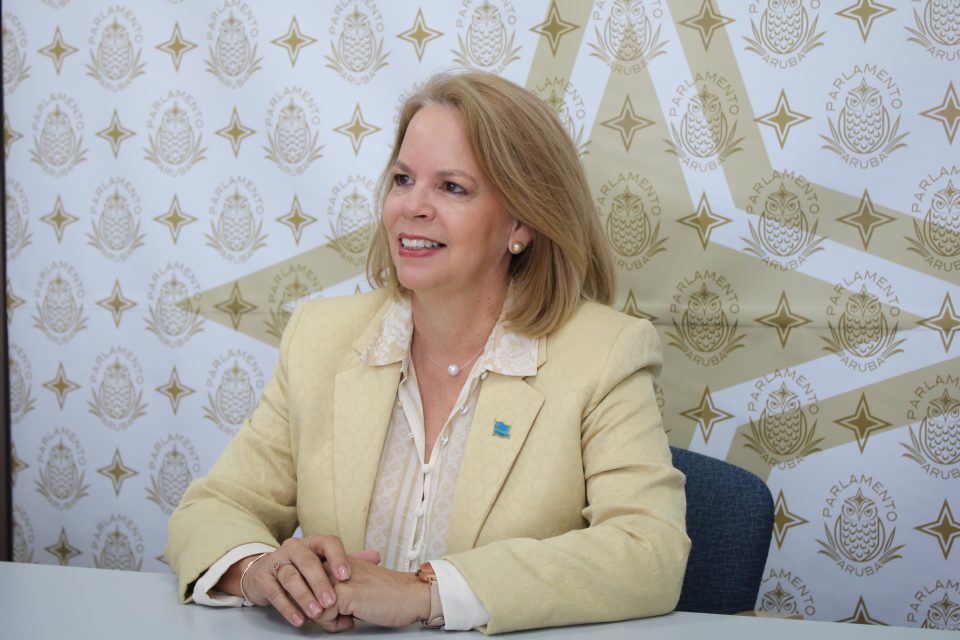
Regarding the issue surrounding the contract between ATA and Ecotech involving Minister Cicilia, the leader of the MEP fraction, Mrs. Evelyn Wever-Croes, expressed that good governance is not just about pointing out when things go wrong. According to Mrs. Wever-Croes, good governance also implies offering constructive solutions and sharing suggestions to ensure that processes of public interest run better in the future. With that goal in mind, she presents four key lessons to prevent doubts and reinforce the transparency that the people of Aruba demand.
Four key lessons for the future
Mrs. Wever-Croes clarified that she does not question the importance of the project to improve waste management in Aruba, but rather the way the process was executed.
*Every minister must act within their responsibility: The Minister of Tourism must focus on their portfolio of tourism and labor, while the minister in charge of waste management should guide and coordinate projects of that nature, as prescribed by law.
*ATA must stay within its legal role: ATA can contribute to national projects, but always within the framework of its legal duties. An alternative would have been for ATA to pay an additional dividend to the Country of Aruba for the amount of the contract, so that the competent minister and SERLIMAR could then conduct the negotiation, evaluation, and signing of the project.
*Transparency begins with public bidding: When the law requires a public bidding process, that procedure must be followed. Even in urgent situations, the law offers specific mechanisms to act swiftly without setting aside the principles of transparency.
*Avoid any appearance of conflict of interest: If a board member did not participate in a decision due to a possible conflict of interest, it is fundamental that they do not sign the corresponding documents or contracts either. This step guarantees transparency and strengthens trust in the process.