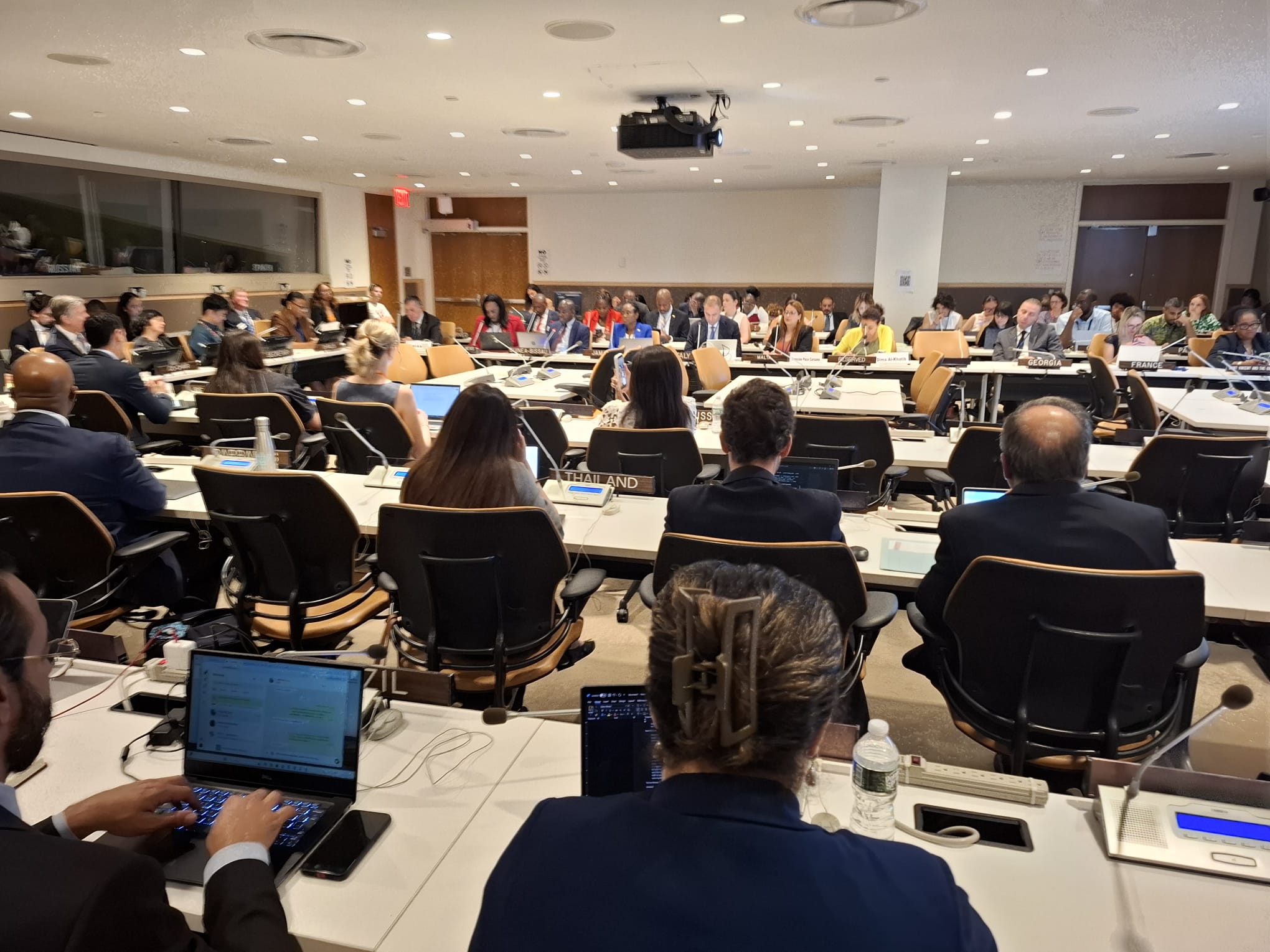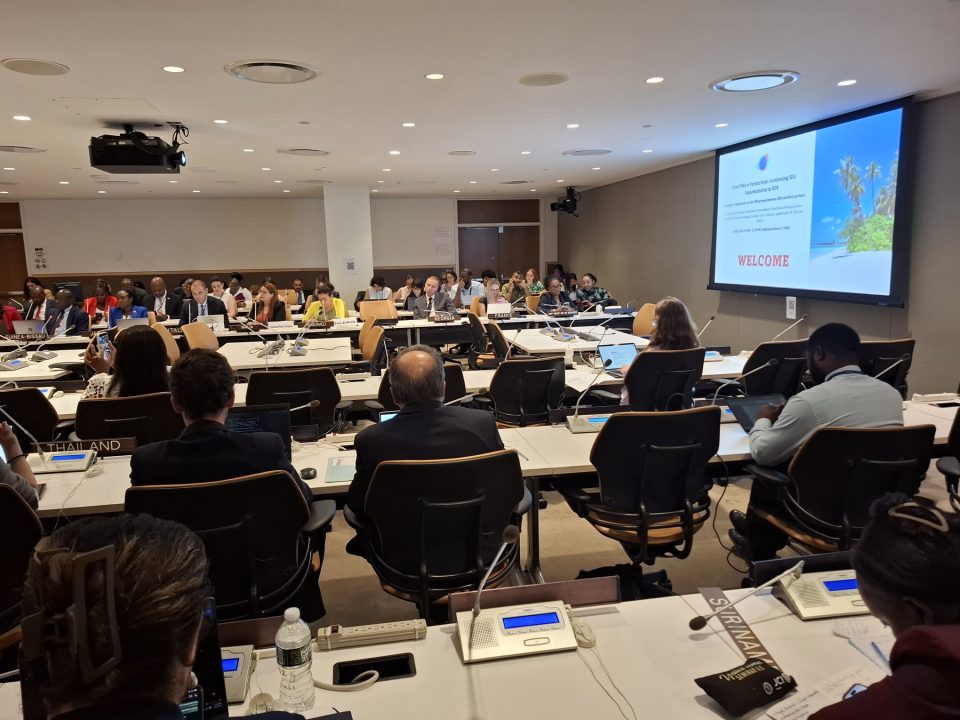
The Social and Economic Council (SER), as part of a delegation from the International Association of Economic and Social Councils and Similar Institutions (AICESIS), is participating in the ministerial segment of the High-Level Political Forum on Sustainable Development (HLPF) in New York. At the opening, UN Secretary-General António Guterres, President of the 80th session of the General Assembly Annalena Baerbock and President of the United Nations Economic and Social Council Lok Bahadur Thapa delivered the same urgent message: the world has solutions, but implementation of the 2030 Agenda is too slow and fragmented. For Curaçao, that call directly concerns choices on water, energy, infrastructure, housing, digitalisation and jobs.
This year, the HLPF is reviewing progress on clean water and sanitation, affordable and clean energy, industry and innovation, sustainable cities and international partnerships. The figures make clear why acceleration is needed. Of the 139 SDG targets for which sufficient data are available, only 36 per cent are on track or showing moderate progress. Nearly half are progressing too slowly, while 15 per cent have regressed since 2015.
Guterres placed that shortfall in a broader international context. High debt levels, rising financing costs, climate change and armed conflicts are reducing the space to invest in education, healthcare, social protection, energy security and infrastructure. In his view, sustainable development can accelerate only if countries have sufficient financing space and policy areas are no longer treated in isolation. Water, energy, innovation, urban development and social protection must reinforce one another. Peace and international stability are also indispensable.
The Secretary-General also pointed to the development potential of renewable energy, digital technology and artificial intelligence. These can raise productivity, improve public services and create jobs, but only if access to infrastructure, data, skills and capital is made broadly available. The environmental effects of digitalisation, including the energy and water used by digital systems, must also be explicitly taken into account.
Baerbock warned against cynicism and resignation as 2030 rapidly approaches. In her view, the progress made since 2015 on drinking water, sanitation, electricity and internet access shows that international goals can be achieved when political will, investment and cooperation come together. Especially at a time of geopolitical division, multilateral cooperation remains essential for problems that no country can solve alone.
Governments cannot do this without employers, workers, civil society organisations, research institutions and the financial sector. Baerbock also called for progress to be assessed more broadly than through gross domestic product (GDP) alone. Indicators of livelihood security, health, education, inequality, the living environment and resilience show more clearly who benefits from economic development and where policy falls short.
Thapa emphasised implementation and demonstrable results. Countries should not lower their ambitions, but remove administrative, financial and institutional bottlenecks and apply proven solutions more quickly. Particular attention is needed for countries and island economies facing high capital costs, limited implementation capacity, natural hazards and recurring external shocks.
The HLPF must therefore continue to evolve from a forum that mainly reviews progress into a platform that helps countries with implementation, knowledge exchange, institutional strengthening and partnerships. Voluntary National Reviews can also be used for that purpose. The ultimate test is not the number of declarations or reports, but tangible improvements in people’s daily lives.
For Curaçao, the three messages converge in a single policy imperative: organise implementation around a limited set of interconnected priorities. As a small, open island economy, Curaçao is vulnerable because of its dependence on imported energy, international price movements, high capital costs and supply-chain disruptions. Its small scale also offers an advantage, however: policy areas can be linked more quickly, responsibilities can be assigned more clearly and social partners can be involved early in implementation.
The link between water and energy is the clearest example. Producing drinking water requires large amounts of energy, meaning that international fuel prices feed through into costs for households, businesses and public services. Investments in renewable energy, storage, a reliable power grid, more efficient water use and reuse can therefore strengthen purchasing power, competitiveness and climate resilience at the same time.
The same applies to infrastructure and digitalisation. Network modernisation, reliable connectivity, cybersecurity and the responsible use of data and artificial intelligence are prerequisites for higher productivity and better public services. Education, vocational training and labour-market policy must be aligned with these developments so that local workers and entrepreneurs can genuinely participate in new activities and the digital transition does not widen existing inequalities.
Housing and spatial development cannot be separated from livelihood security either. The availability and affordability of housing, mobility, access to jobs and services, and the quality of the built environment directly affect social participation. Climate adaptation and the protection of vulnerable groups must therefore be integral parts of housing-market and infrastructure policy.
None of these challenges can be addressed by government alone or solely with national resources. Curaçao needs predictable regulation, reliable data, affordable financing and cooperation within the Kingdom, across the Caribbean and Latin America, and with international institutions. Structured dialogue with employers, workers, civil society organisations and experts is needed to turn choices into workable measures and distribute the costs and benefits of transitions fairly.
The presence of the AICESIS delegation, which includes the SER of Curaçao, brings the voice of organised socioeconomic dialogue to the HLPF. Economic and social councils can translate global agreements into policies that can be implemented nationally, bring different interests in society together at an early stage and help ensure that economic progress goes hand in hand with social justice. For Curaçao, participation also provides access to international knowledge, experience and opportunities for cooperation.
The joint call from New York is therefore concrete: the remaining years to 2030 must not be dominated by new reporting cycles, but by clear priorities, financing, implementation and measurable results. Affordable water and energy, future-ready jobs, inclusive digitalisation, adequate housing and climate resilience are not separate policy areas for Curaçao, but one agenda for broad well-being and economic resilience.