


Ihave spent some time reading and rereading the judgment against former minister O. Oduber in what has become known as the “Flamingo” case. The more I read it, the more I am left with a fundamental concern. The Court is entitled to scrutinize political appointments, and I do not believe ministers should be exempt from criminal responsibility when public money is involved. My concern is that the Court appears to have judged these appointments without sufficiently understanding, or at least establishing in its judgment, the political and organizational reality in which such appointments operated.
That distinction is important. A court is perfectly entitled to conclude that an established political practice is unlawful. The fact that something has been done for decades does not make it legal. But before we can characterize conduct as criminal fraud, we first need to understand what the arrangement was, what rules applied to it, what was represented to the decision-makers, and exactly what made that representation false.
This matters because the Court itself acknowledges that political appointments were permitted and that ministers had considerable freedom in composing their ministerial bureaus. I know this environment not from textbooks but from having worked in it, decades ago. That does not make my interpretation legally decisive, but it does give me a different perspective when I read a judicial description of how a ministerial bureau supposedly functions.
The Problem With the Term “Spookambtenaar”
Let us start with the terminology.
“Spookambtenaar” is a powerful word. It immediately creates an image of a civil servant who receives a government salary, never shows up to work, and does absolutely nothing. Once that image is established, the conclusion almost writes itself. But the two persons I will discuss, whom I will simply call Person X and Person Y, were not ordinary civil servants appointed by landsbesluit. They were arbeidscontractanten working under private-law employment agreements. That distinction matters.
Political employees and other contract workers do not necessarily function like career civil servants within a government department. They may be hired because a minister trusts them, because they have a political relationship with the minister, or because they perform functions around the political organization that do not fit neatly into the traditional civil-service structure. We can debate whether that system is desirable. Perhaps it has become too flexible. Perhaps it needs substantial reform. But when a criminal court assesses such an arrangement, it must first assess the arrangement that actually existed. A label cannot do the work of legal analysis.
How Political Staff Actually Work
Anyone who has worked closely with government and politics knows that a minister does not operate alone. A chef de bureau or chief of staff, advisers, liaison officers, secretarial personnel, and others perform different functions around the political leadership.
Their work can be broad. They may maintain contacts with neighborhoods and community organizations, accompany the minister, attend meetings, organize activities, deal with citizens, coordinate appointments, assist with speeches or social media, maintain political contacts, or perform work outside the government office. Political loyalty and trust also matter. That should surprise nobody. These are political appointments. People frequently arrive with an administration and leave when the political circumstances change.
Another reality is perhaps even harder to understand from outside the system. The minister who formally employs a person is not necessarily the minister for whom that person will ultimately perform most of his work. A minister may want to bring somebody into government but may not have the budget, space, or administrative possibility within his own ministry. Another minister may have that possibility. The person can therefore be formally contracted through one minister or ministry while, in political and practical terms, working for or around the minister who brought them into government. In such a situation, the contracting minister may have had little involvement with the person’s actual day-to-day activities. The political understanding was that one minister facilitated the appointment while the person, in practice, worked for or around another.
Is that the ideal way to organize a modern public administration? That is a completely different question. I am explaining how the political machinery has operated. And that matters. If you later reconstruct the employment relationship by looking only at the formal line on the paperwork, you may reach a conclusion that does not correspond with the political reality in which the arrangement was created.
The Reality of Political Appointments
There is an important distinction here that I believe we need to confront honestly. These were politically driven appointments, and we cannot discuss them as though they existed outside Aruba’s political history.
Over the past forty years, many people have entered government through political appointments and gone on to do excellent work for Aruba. Some became valuable advisers, staff members and public servants who contributed enormously to this country. But if we are going to have an honest conversation, we must acknowledge the other side as well. For decades, governments of different political colors have also appointed people because they were family members, trusted political supporters, loyal campaign workers or people whom a politician felt politically obligated to accommodate. In our political culture, supporting a politician has often carried an expectation that, if that politician reaches government, a job or some form of government employment may follow.
Some of those political appointees worked every day inside a government building. Others did not. Some worked primarily around the minister’s political organization, maintaining contacts in neighborhoods, helping with political activities, dealing with supporters, organizing events or doing whatever the political operation required. Some may have done very little at all. We should be honest enough to acknowledge that too.
We may dislike that system. We may consider it outdated, unfair or an improper use of public resources. We may decide, after forty years of Status Aparte, that Aruba should finally put an end to it. Those are legitimate conclusions. But we cannot erase the fact that this political culture was allowed to develop and persist across successive governments and then, without identifying the rule that makes the crucial distinction, simply transform the existence of that culture into proof of criminal fraud.
That is particularly important in the case of an employee who asks the employer for work and is not given any. There is a fundamental difference between entering into an employment agreement that everybody knows from the outset is a sham and entering into a real political employment relationship in which the employer subsequently provides little or no work. The latter may demonstrate terrible management. It may demonstrate political patronage. It may demonstrate that government received almost nothing in return for public money. But none of those conclusions, by themselves, establishes that the employment agreement was fraudulent from its inception.
And that is precisely where criminal law requires us to be disciplined. We cannot move from “this was a political appointment,” to “this person did very little work,” to “therefore the appointment was fictitious,” and finally to “therefore there was criminal fraud,” as though each conclusion automatically proves the next.
It does not.
If Aruba wants to say that a political supporter may no longer be employed unless that person performs specifically defined governmental duties, then establish that rule. If political work may never be performed during a government employment relationship, establish that rule. If every arbeidscontractant must report to a particular official, work from a government office, maintain fixed hours and document his output, establish those rules as well.
But we should not confuse the absence of rules we now wish had existed with proof that somebody committed a crime under the rules that actually existed at the time. Poor administration is not criminal fraud. Political patronage is not automatically criminal fraud. And an employment relationship does not become fictitious merely because, looking back, we conclude that the government should never have entered into it. If the State says this particular arrangement crossed the line into criminal fraud, then tell us where that line was, what rule established it, and what evidence proves that it was crossed.
How the Council of Ministers Actually Works
I describe these practices not to defend them, and certainly not to suggest that political custom can override the law. I describe them because they form part of the factual environment in which these decisions were made. If a criminal conviction depends on what ministers understood, what they represented to one another, and what led the Council of Ministers to approve an appointment, then how the institution actually functioned matters. A court may ultimately conclude that the practice was unlawful, but it must first understand it before deciding that someone used it to deceive.
For me, this is where the political reality becomes particularly important. The Court considers it plausible that if the Council of Ministers had known the “real situation,” it would not have approved the appointments. But how do we know that? A Council of Ministers is not simply an HR committee where every minister interrogates every other minister about the political people he wants to appoint. That is not how ministers’ political relationships have traditionally operated in Aruba.
Trust, reciprocity, and political respect matter. A minister brings forward somebody he wants within or around his political organization, and his colleagues will generally respect that choice. Tomorrow another minister brings forward his person and expects the same consideration. Put simply: I respect your political appointment, and you respect mine. None of this is likely to be found in a statute, regulation or university textbook. It is institutional practice: the unwritten political conventions through which government has operated over decades. Those conventions do not override the law, but they matter enormously when determining what ministers understood, what they expected from one another and whether anyone was actually deceived
The judgment itself recognizes that political appointments were permitted and that ministers had considerable freedom in composing their bureaus. It also records that the Council assessed personnel proposals based on trust. It means that when the Court concludes that the Council would not have approved these appointments had it known the “real situation” we should ask what evidence supports that counterfactual conclusion. Which ministers said they would have voted differently? What information would have changed their decision? What did ministers ordinarily expect to know about another minister’s political employees? Did they normally investigate who would give daily instructions, where the employee would sit, what activities the person would perform, or whether the person might in practice assist another political office?
Perhaps there are answers. But those answers cannot come from imagining how an ideal Council of Ministers should operate. They must come from understanding how the Council actually operated. Ask those who have been there. Ask any former or current minister, chief of staff, or senior advisor who can speak from experience.
Forty Years of Political Practice Matter
Aruba has now lived with Status Aparte for forty years. During that period, our political institutions have developed not only through laws, regulations, and organizational charts, but also through practices, conventions, and understandings among the people who operate them. I am not suggesting that everything politicians have done repeatedly for forty years somehow becomes law. It does not. A bad practice does not become lawful merely through repetition, and political convention cannot override the Criminal Code. But we also cannot pretend those conventions do not exist when we are trying to determine what political actors understood, why they approved something, and whether they were deceived.
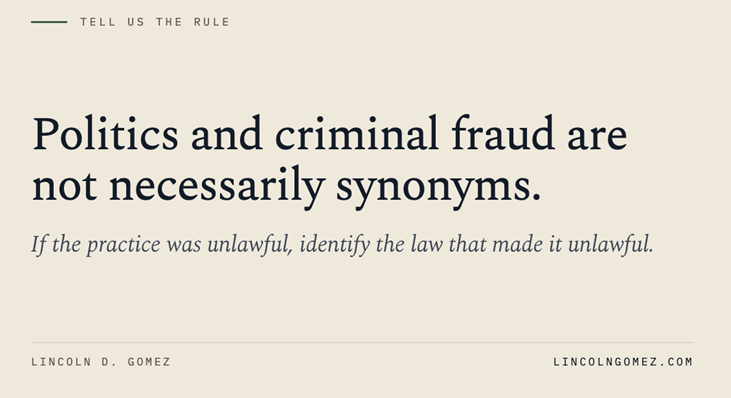
There is law in the books, and there is the institutional reality in which that law operates. Ultimately, the courts must apply the law in the books. But they cannot intelligently apply that law without understanding the reality in which the relevant decisions were made. If the practice was unlawful, identify the law that made it unlawful. If the practice facilitated fraud, prove the fraud. If the practice is undesirable, we, the people, have to change it. But first, understand it.
Political Reality Is Not a Criminal Defense
I want to be absolutely clear about this because my argument should not be misunderstood.
“This is how politics works” is not a defense to fraud.
If a minister deliberately places somebody on the government payroll while everyone involved understands that there will be no genuine employment relationship, deceives the relevant decision-makers, and thereby causes public money to be paid, the fact that similar things may have happened before does not make that conduct lawful. Political culture does not override criminal law. But criminal law cannot be applied in a vacuum either. Before a court can determine that someone deceived a system, it must understand the system allegedly deceived. That distinction matters in this case.
If the Culture Must Change, Change the Rules
Perhaps Aruba should change the way political appointments work. There is certainly an argument for much clearer rules.
If every political employee should have a detailed written job description, require one. Because normally it is merely a template with names, functions, and dates replaced. If working hours must be recorded, introduce that requirement. If employees must work from government premises, put it in the rules. If outside activities require permission, regulate them clearly. If ministers must document assignments to political staff, establish that obligation. If there should be limits on political appointments, legislate those limits.
Clear rules protect everyone. They protect the public purse, employees, ministers and ultimately the courts because they make it much easier to distinguish poor administration, political patronage and criminal conduct. What is concerning, is reversing that sequence: deciding today what good public administration should look like, applying that model to a political system that developed differently over decades and then treating the difference as evidence that yesterday’s conduct was criminal. That is a dangerous shortcut.
Tell Us the Rule
I have no difficulty accepting that Aruba’s political culture deserves scrutiny. Many of us have been part of that political world and know we should examine some practices critically and change others. But criminal law requires more precision than political commentary.
If Person X and Person Y were employed under private-law employment agreements, tell us what those agreements required. If liaison officers had specific mandatory duties, show us where those duties were established. If their work had to be personally assigned by the minister, identify that requirement. If the Council of Ministers would have rejected their appointments had it known particular facts, show me the basis for that conclusion and also show me that you considered the correct political context. Then we can properly discuss whether the line into criminal fraud was crossed.
What troubles me about this judgment is the possibility that the Court did not merely judge the political reality that existed, but first constructed its own understanding of how that political reality should have operated and then judged the conduct against that standard. That is ultimately a question the Supreme Court can examine without reweighing the facts: whether the Appellate Court applied the correct legal standard and whether the norm on which this criminal conviction rests was sufficiently established.
A court may condemn fraud. It may condemn fraud even when fraud has become part of an accepted culture. But when we use criminal law, particularly against people operating inside a political and administrative system that government itself has allowed to develop over decades, we must be able to answer one simple question:
What, exactly, was the rule?
Have a great weekend, and I will see you again next week.
In the meantime, please visit my new website, www.lincolngomez.com, where you can find all my blogs and podcasts.
10 October 2026