In a joint statement, ten labor organizations assert that the proposal by State Secretary Eric van der Burg ignores Aruba’s unique constitutional position and represents a “clear regression” for its autonomy.
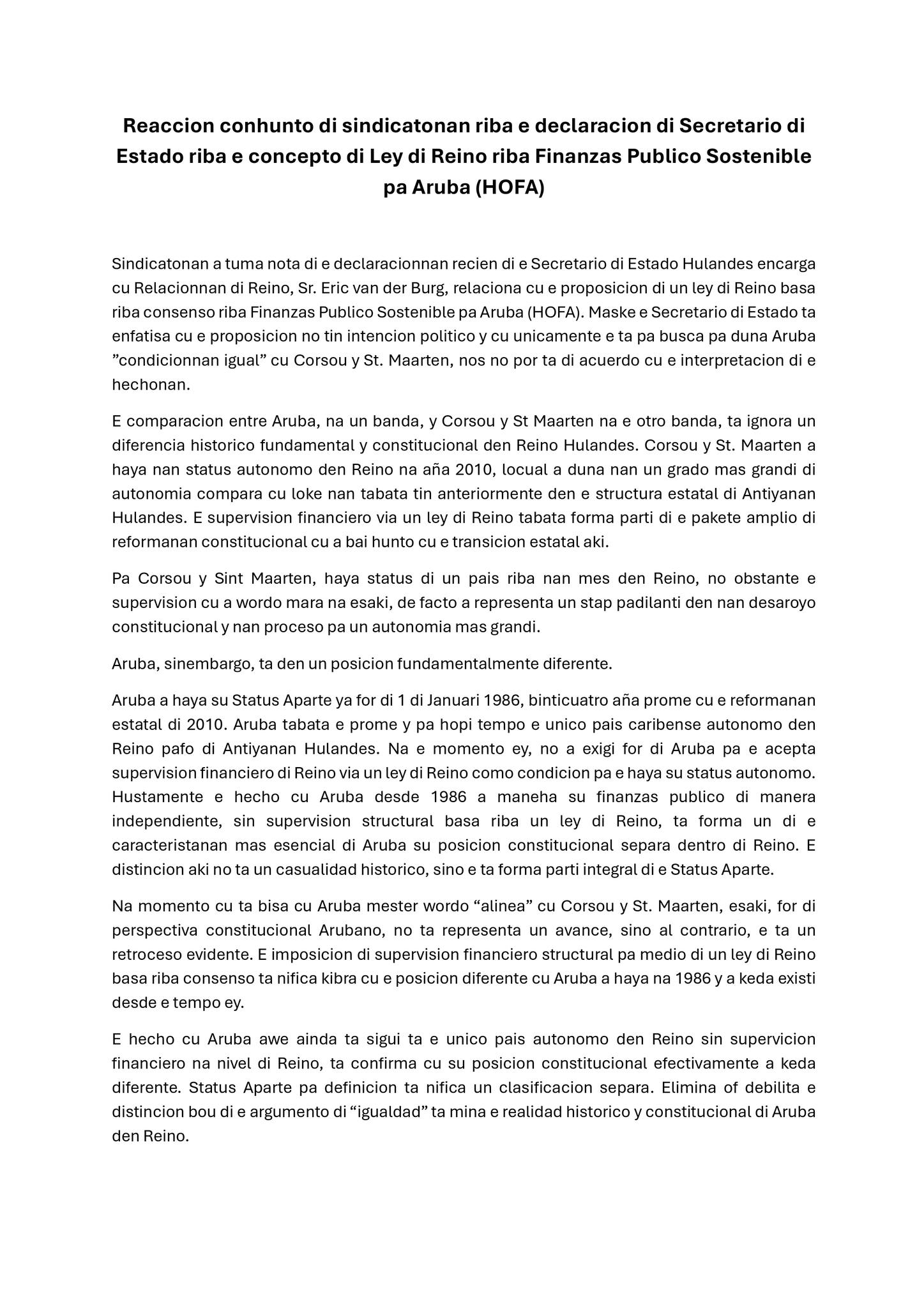
The leadership of Aruba’s labor unions has raised a strong and united voice against the recent statements made by the Dutch State Secretary for Kingdom Relations, Mr. Eric van der Burg. This rejection is directed at the proposal for a Kingdom Law regarding Sustainable Public Finances for Aruba (HOFA). Although the Netherlands asserts that the intention lacks political motives and merely seeks to grant Aruba “equal conditions” to Curaçao and St. Maarten, the unions structurally disagree with this interpretation of the facts.
The “Equality” Argument Ignores Constitutional History
According to the presented official documents (referencing 1.jpg and 2.jpg), the comparison being made between Aruba on one side, and Curaçao and St. Maarten on the other, completely overlooks a fundamental historical and constitutional difference.
Curaçao and St. Maarten acquired their autonomous status within the Kingdom in the year 2010. For them, financial supervision tied to a structural Kingdom law formed an integral part of a broad package of constitutional reforms that accompanied their state transition. Therefore, for those islands, that step represented progress in their autonomy.
Aruba, however, is in a completely different position:
Aruba acquired its Status Aparte on January 1, 1986, twenty-four years before the 2010 reforms.
At that time, the Kingdom did not demand that Aruba accept financial supervision via a Kingdom law as a condition for its autonomous status.
Managing public finances independently, without structural supervision from abroad, is one of the most essential characteristics of Aruba’s separate constitutional position.
“When it is said that Aruba must be ‘aligned’ with Curaçao and St. Maarten, from an Arubanese constitutional perspective, this does not represent an advance, but on the contrary, it is a clear regression.”
Proven Capacity for Self-Governance
The unions emphasize that Aruba has clearly demonstrated in recent years that, without the need for structural supervision based on a Kingdom law, it was capable of providing better direction and making the necessary progress to get its public finances in order.
Imposing structural supervision now would mean breaking away from the unique legal and structural position that Aruba has held since 1986. Furthermore, the parties explain that introducing this would be very difficult to reconcile with the principle of autonomy upon which the Charter for the Kingdom (Statuat) is built.
A Solid Union Front
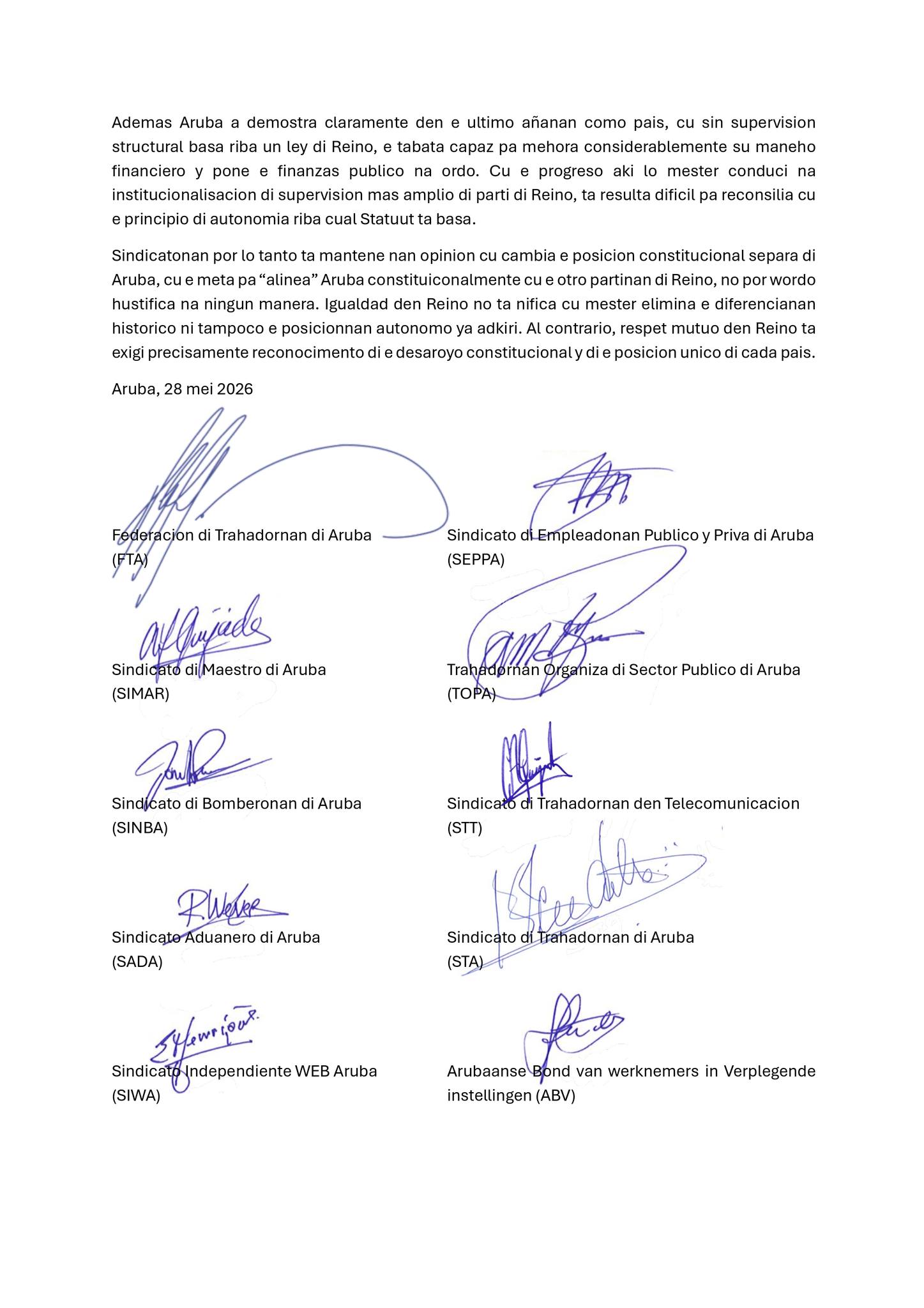
The communique, officially dated May 28, 2026, comes with the signatures and approval of the complete union front, representing the public sector, private sector, education, security, telecommunications, customs, and healthcare.
The ten labor unions that signed this joint stance are:
FTA (Federation of Workers of Aruba)
SEPPA (Union of Public and Private Employees of Aruba)
SIMAR (Teachers’ Union of Aruba)
TOPA (Organized Workers of the Public Sector of Aruba)
SINBA (Firefighters’ Union of Aruba)
STT (Telecommunications Workers’ Union)
SADA (Customs Union of Aruba)
STA (Workers’ Union of Aruba)
SIWA (Independent Union of WEB Aruba)
ABV (Aruban Union of Employees in Nursing Institutions)
The unions conclude their letter by demanding a petition for mutual respect within the Kingdom, which must include giving structural value and recognition to the constitutional development and unique position that each autonomous country possesses.