

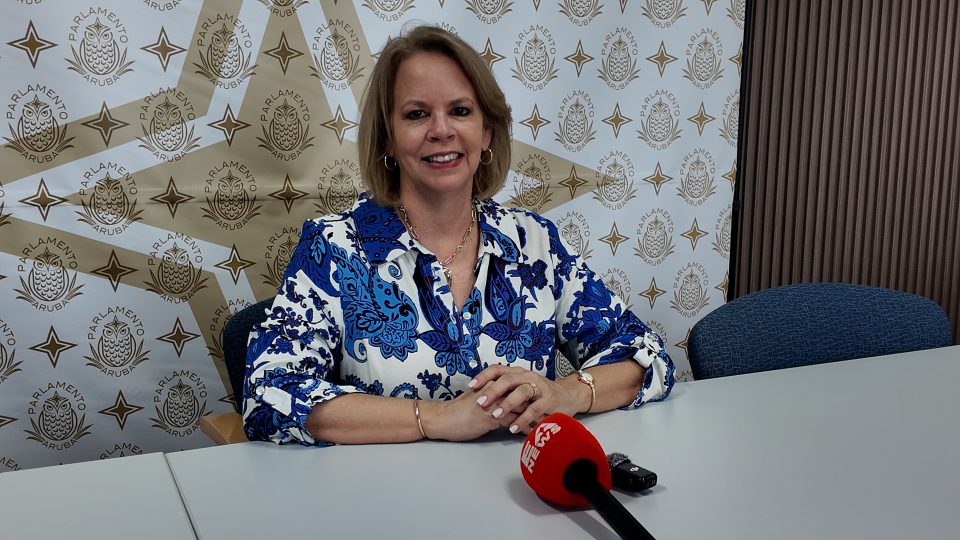
After Parliament approved an investment fund with a minimal majority of just eleven votes, the Leader of the People’s Electoral Movement (MEP) parliamentary faction, Evelyn Wever-Croes, came forward to explain the reasons why her faction voted against this proposal.
According to Wever-Croes, it is very important to clarify that the MEP faction is not opposed to the concept of investing in Aruba. On the contrary, she pointed out that the main goal of generating a budget surplus is precisely to have resources available to invest in items requiring attention on the country’s agenda. However, the way this investment fund was structured presents two fundamental objections: a significant financial deficit and the weakening of parliamentary oversight mechanisms.
A deficit of 26 million florins
The first primary point of concern for the MEP faction is the lack of financial resources to cover the proposed projects. The government presented a ministers’ wish list totaling 59.5 million florins in projects they wish to execute. However, the fund only holds 33 million florins in actual cash.
“Meaning, there remains a deficit, a financial hole of 26 million florins. They came forward with a deficit-ridden fund, and we in the MEP faction do not approve of that. We have already seen what deficits have done to Aruba in the past,” declared Wever-Croes.
The faction leader recalled the consequences of the mega-debts generated in the past, referring to the previous cabinets of Mike Eman 1 and 2, noting that those debts caused severe financial pain for the country—pain that the public is still paying off. For this reason, MEP refuses to support any initiative that reintroduces the risks of a deficit.
Lack of transparency and arbitrariness
The second major objection concerns the lack of transparency and the removal of proper parliamentary oversight. According to Wever-Croes, the project list lacks a clear sequence as well as proper review by the Evaluation Committee, which by law is required to evaluate every single project.
The MEP leader explained that the government did not send all projects for evaluation, but only a few that dated back to the previous administration. The remaining projects remain without formal evaluation and are managed based on what she described as “willekeur” (arbitrariedad/arbitrariness). This means that whichever project exerts the most pressure or makes the loudest threats will get priority for execution.
In conclusion, Wever-Croes emphasized that this Investment Fund does not represent a responsible way to govern or manage the public’s resources.
“By bypassing the function of this Evaluation Committee, it fails to provide a clear picture or transparency. For these reasons, and several others, MEP voted against this investment fund,” the MEP Faction Leader concluded.