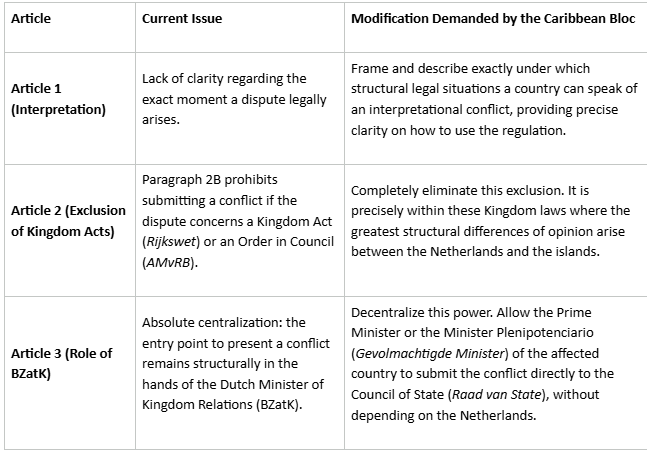
The coalition and unity as a bloc between Aruba, Curaçao, and Sint Maarten has entered its most crucial phase. During the tripartite debates in the Netherlands, the Caribbean delegations presented a united front to demand deep modifications to the draft of the Geschillenregeling (Dispute Regulation). The islands stand firm that the current document structurally weakens their position and infringes upon their autonomy, specifically through three paramount articles.
According to Curaçao Parliamentarian Ramon Yung, the delegations’ goal is to prevent this regulation—which has been under constitutional discussion for years—from becoming an ineffective tool. For this reason, a concrete proposal was formulated to change the structural pillars of the legal text:
The Three Articles in Focus: Protecting Autonomy
“Centralization in the hands of BZK attacks the autonomy of the countries. As an autonomous country, if you have a dispute, you must have the right to present it directly for evaluation,” the delegations emphasized, backing the original advice of the Council of State, which the Netherlands disregarded in the current draft.
The implementation of the same united front that yielded successful results in the Landspakket debates—achieving a mutual agreement instead of a COHO Kingdom Act—is the islands’ best calling card. However, the sentiment in the Dutch House of Representatives (Tweede Kamer) presents a two-sided scenario:
The Challenge of Dutch Centralism: Traditionally, there are structurally conservative factions in the Dutch Parliament that view the centralization of power within BZK as a way to maintain “control and supervision” over Caribbean funds and governance. For these parties, opening up Articles 2 and 3 means weakening The Hague’s authority.
The Success Argument (2023–2026): On the other hand, the Caribbean delegations arrive at the table with a positive evaluation report of the Landspakketnan. The islands have demonstrated that they can govern, implement reforms, and remain reliable without the need for an imposed Kingdom Act. This political and technical maturity forces more moderate and progressive Dutch parliamentarians to listen and value these requests.
The wind is favorable for the islands if they maintain this closed block. Tomorrow, when the formal debates of the Interparliamentary Kingdom Consultations (IPKO) begin, the Dutch delegation will encounter three countries that will not accept a weak regulation. The Caribbean determination is clear: the Geschillenregeling must be a tool for equal justice within the Kingdom, and not just another instrument of political dominance.