

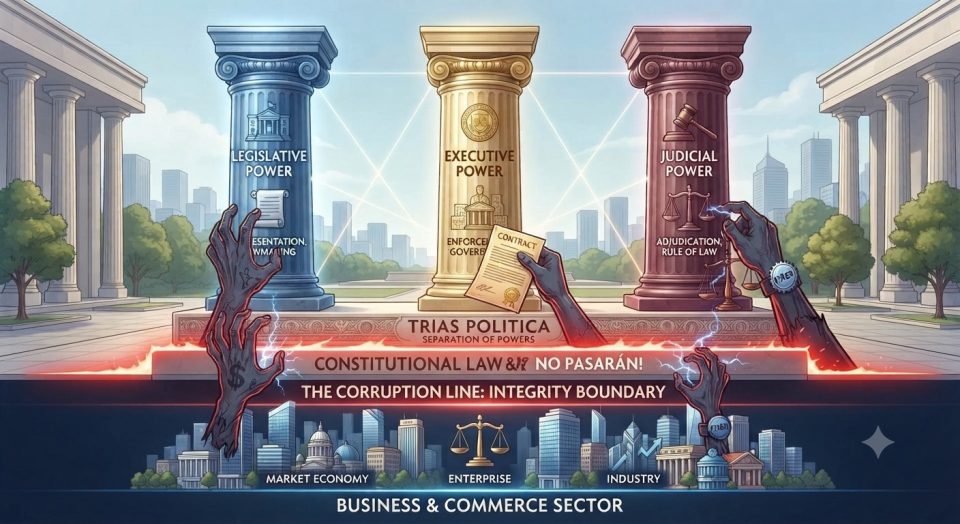
Trias Politica and the Red Line: Governance, Commerce, and Integrity
The Trias Politica, introduced by the philosopher Montesquieu, is the pillar of a democratic rule of law. It is the principle that state power should not be in the hands of a single person or entity, but divided into three independent powers to prevent abuse:
• Legislative Power: Those who create the laws (Parliament).
• Executive Power: Those who execute the laws (Government/Ministry).
• Judicial Power: Those who interpret the laws and judge conflicts (Judge/Court).
The Role of Commerce In a healthy society, the commercial (private) sector is not part of the Trias Politica, but it is a fundamental actor that depends on it. The necessary “distance” between commerce and government is what we call institutional integrity. Commerce must use established channels to make requests like any other citizen; no one should have priority over another. Therefore, the government must ensure that service departments are stable and optimal to serve commerce and the community equally, so that political favors are not requested.
What is the “Red Line”? It is the boundary where private interest (profit) begins to influence public interest (general welfare). This line is crossed when there is:
• Favoritism and “Cronyism”: Government granting contracts, permits, or tax advantages based on personal relationships or political donations, rather than merit or the country’s best interest.
• Undue Lobbying: Commerce using financial power to “buy” influence in legislative processes.
• State Capture: When the commercial sector has so much power that the government does not govern for the people, but for the interests of a powerful business group.
Why is this distance vital?
1. Protecting Free Competition: Excessive closeness creates an uneven playing field, harming innovation and quality for the citizen.
2. Ensuring Public Trust: If decisions are dictated by the “business elite,” democratic trust breaks down, which can lead to social instability.
3. Avoiding Corruption: The separation acts as a “check and balance.” Does Aruba’s newly passed investment fund have these checks and balances? The judiciary must remain independent to investigate and punish illegalities without fear or favoritism. What happens if the line is crossed with the support of puppets in parliament?
4. Taxation and Regulation: The government has a duty to regulate the market (protecting the environment, labor rights, and security). Is the AVP-FUTURO
government fulfilling this? Without distance, the government becomes “soft” or complicit, putting the population’s welfare at risk.
Conclusion The commercial sector is the engine of the economy, but it cannot be the helm of the political ship. The red line is integrity: the government must be an impartial referee. When this distinction becomes doubtful, democracy loses its value, and the economy becomes an instrument of those with the most money, instead of an instrument of progress for the entire nation of ARUBA.
Do you believe this distinction is sufficiently respected on our island, or do you see signs that the red line is becoming more subtle?