

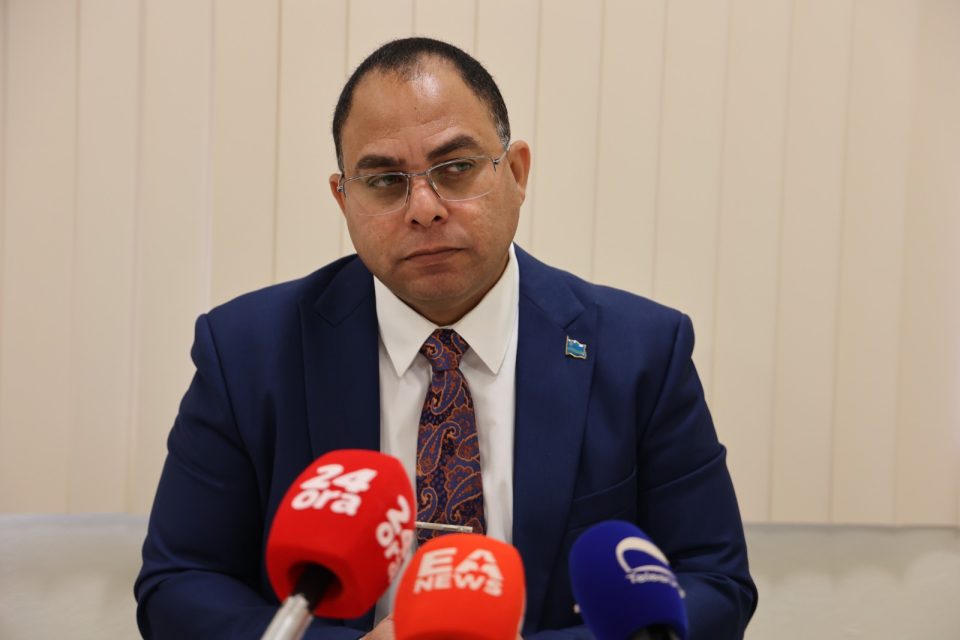
How much does Aruba actually save with the Rijkswet HOFA? And more importantly: what does Aruba have to give up in return? This is the question that PPA faction leader Eduard Pieters places at the center of the debate concerning the Rijkswet HOFA and the National Ordinance on Guaranteeing Sustainable Public Finances (LWHO). According to Pieters, the Government presents figures in the millions of florins without sufficiently explaining that these amounts are calculated over a long period.
“If you are talking about large figures that used to be 800 million florins and are now barely over 100 million, you must also tell the people based on how many years this figure is distributed.”
Do not just give the people the big figure
Pieters is reacting to the recent statements by Deputy Prime Minister Gerlien Croes, who mentioned a financial benefit of approximately Afl. 136 million related to the COVID loan and that after meeting various criteria, the Netherlands might refinance Aruba’s other loans. Pieters pointed out that the presentation Parliament received from the Minister of Finance, Geoffrey Wever, paints a completely different picture.
According to the calculation presented by Pieters, the interest reduction on the COVID debt can represent approximately Afl. 128 million, but split over a 16-year period.
“That is not 128 million a year. It is around eight million florins a year!”
Saving money at what cost?
His political conclusion is that the actual annual benefit, depending on the calculations and facilities Aruba ultimately receives, fluctuates around Afl. 8 million a year regarding the COVID loan.
Pieters does not minimize the importance of interest reduction. “Of course we want to pay less interest. There is no politician or Aruban who does not want that.” But the question is not whether Aruba wants to save money. The question is: At what price are we saving this money? The fundamental question is: Do we want to break our Constitution to get an interest reduction?
21 criteria that Aruba must meet
Pieters pointed out that the financial facilities to refinance Aruba’s other debts do not come automatically, since Aruba must meet several of the 21 criteria. Therefore, he questions the way the public debate on the true financial benefit is being rushed, while the institutional conditions and consequences receive much less attention.
“We must speak well-documented. Not just talk about a small bag of money.”
According to Pieters, among the points that need to be analyzed are the violation of our Constitution, the loan facility, the future of financial supervision, and the conditions under which Aruba is supposedly able to exit the Rijkswet.
For PPA, these are not technical details, as they directly touch the future of Aruba’s autonomy and its Constitution.
Supervision yes, but not at any price
Pieters emphasizes that PPA is not against financial supervision. Nor is the debate between responsibility and irresponsibility. Aruba must have budgetary discipline, supervision, and sustainable public finances. But according to Pieters, that can be regulated without unnecessarily giving up the power Aruba has as an autonomous country anchored in its Constitution and the Kingdom Charter. And precisely here he launched the question the Government must answer: If the actual financial benefit is around 20 to 22 million florins a year, is that the price to break our Constitution and compromise Aruba’s autonomy for the next generations?
For Pieters, a decision of this magnitude cannot be sold with a figure of “over 400 million” without the people understanding the full period, conditions, and consequences.
“We want the interest reduction. Of course we do. But do not sell us a big figure without telling us what we pay in return,” Pieters emphasized. Because the debate about HOFA is not just about money. It is about who will hold power over Aruba’s future.