

Amidst all the show, traveling, announcements, and photo sessions by the Ministers of AVP-FUTURO, there is a reality that becomes increasingly clear: the course of Aruba’s public finances is causing concern. We are not saying that Aruba is in a financial crisis today. The current figures still show a surplus, and the economy continues to generate revenue. But a responsible Government does not look only at today’s balance. It must consider whether today’s decisions remain affordable tomorrow. And precisely there, the signs are concerning.
Expenditures grow faster than revenues
In the 2027 budget, national revenue increases by Afl. 55 million, or 3%, compared to 2026. However, current expenditure increases by Afl. 82 million, or 4%. Among other things, personnel costs rise by Afl. 16 million, goods and services by Afl. 56 million, subsidies and transfers by Afl. 22 million, and interest payments by Afl. 4 million.
An incidental expense can be adjusted. But when an expense becomes structural, it commits money every single year. If revenue drops or tourism takes a hit, permanent expenditure remains. The result is that every new florin is committed before the Government can invest it in schools, roads, healthcare, safety, or culture.
Financial leeway shrinks
In 2027, Aruba budgets nearly Afl. 293 million solely to pay interest. This represents around 15 cents of every florin collected by the Government. That is money that cannot go toward repairing schools, maintaining roads, strengthening the Hospital, or investing in economic development.
Refinancing can help lower interest costs, but it does not solve the problem if the Government continues to use the newly created space to generate more permanent expenses. More structural obligations cannot keep being created without coverage for the future.
Investment falls behind
Another concerning signal is the level of investment. The CAft qualified only Afl. 3.5 million in direct investment outside the AIOF investment fund as marginal compared to the massive task Aruba faces. For the AIOF investment fund, Afl. 11 million is contemplated for 2027, but at the time of the evaluation, neither a complete budget nor a multi-annual investment agenda had been presented. This creates a misleading picture: a surplus can look very nice on paper precisely because necessary projects are not being executed.
Social fund surpluses disappear
However, the most serious sign is the projection for AZV and SVb. According to multi-annual figures, AZV’s surplus is projected to drop from Afl. 74 million in 2027 to barely Afl. 9 million in 2031: a decline of approximately 88%. SVb’s surplus drops from Afl. 40 million to Afl. 11 million: a drop of 72.5%.
The funds are not in a deficit yet. But their margin to absorb an increase in medical costs, more retirees, lower premium income, or an economic shock is becoming smaller every time. At the same time, the funds’ surpluses are being counted as resources to reduce national debt. In 2026, SVb deposited Afl. 50 million with the Country. Such an operation may make financial sense, but only if the Government can demonstrate that the fund retains sufficient liquidity, that there is a minimum reserve, an actuarial projection, and clear repayment terms. An annual surplus is not automatically “free money.” The money must protect the people’s healthcare and pensions, including in difficult years.
The complete picture is still missing
There is another reason for caution: the official definition of the collective sector was expanded from 6 to 34 entities, but not all entities are fully consolidated into the debt and balance calculations. Furthermore, several public companies have yet to present their 2024 annual accounts. While this information is missing, Parliament cannot see the complete fiscal picture. Debts, guarantees, long-term contracts, payment arrears, and potential bailouts of public entities could become obligations for the Country.
The conclusion is clear
This is not a matter of creating panic. It is a matter of anticipating problems before they turn into a crisis. Aruba’s current situation is relatively strong, but the safety margin is becoming smaller every day. Expenditure is growing faster than revenue. Interest is eating up a large portion of every florin. Investment is marginal. AZV and SVb surpluses are dropping drastically. And there is still no complete view of public obligations.
AVP–FUTURO has not yet demonstrated that its financial course is sustainable for the years ahead. The Government must present the full cost of every permanent measure, its source of funding, and its multi-annual effect. It must also publish a concrete investment plan, protect social fund reserves, and provide Parliament with a consolidated framework of all public entities.
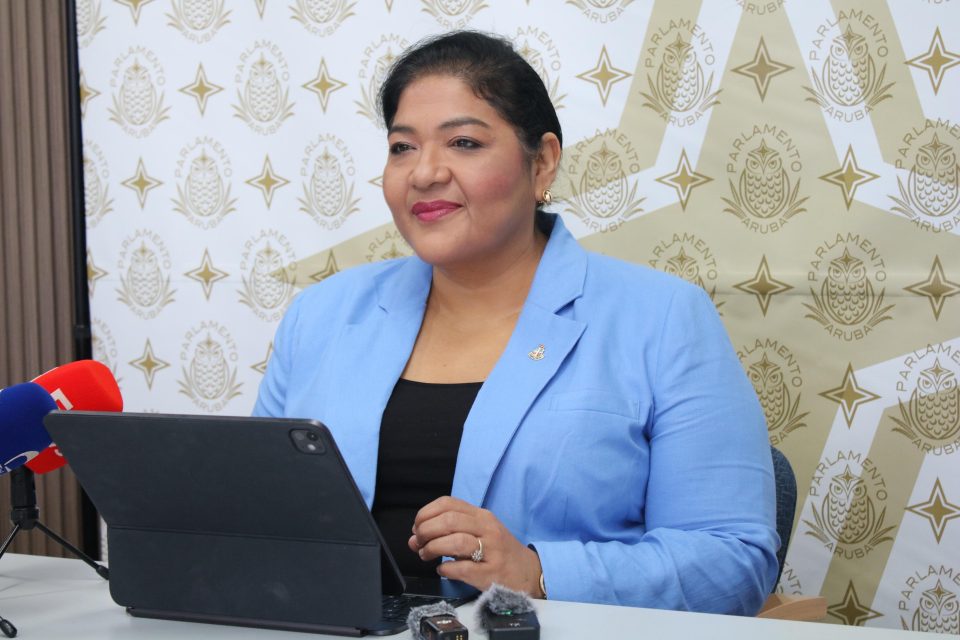
“Show and propaganda can cover reality for a while, numbers cannot,” MP Xiomara Maduro expresses to show her concern over the course AVP-FUTURO is choosing for Aruba.