

In Aruba, political discourse frequently gets twisted in technical jargon. However, for citizens to structurally understand what transpired and who bears the weight of these decisions, it is essential to clear the smokescreen and separate two completely distinct legal and political concepts: the Bestuurlijk Akkoord (Administrative Agreement) and the Rijkswet (Kingdom Law).
The gap between these two concepts is not a mere matter of semantics; it is the difference between a negotiable promise and a binding legal chain of the Kingdom.
To understand the severity of the situation, the framework of both instruments must be laid out with crystal clarity:
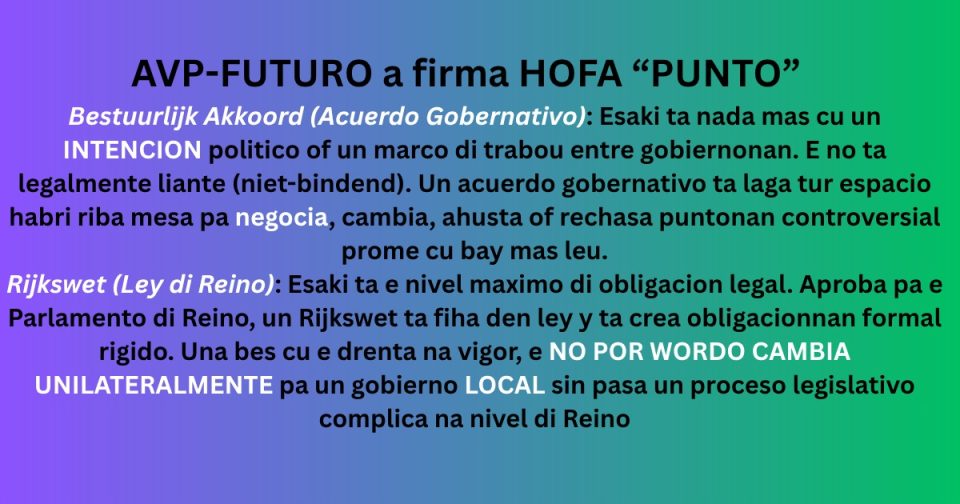
• Administrative Agreement (Bestuurlijk Akkoord): This is nothing more than a political INTENTION or a working framework between governments. It is not legally binding (niet-bindend). An administrative agreement leaves full room on the table to negotiate, alter, adjust, or reject controversial points before moving any further.
• Kingdom Law (Rijkswet): This represents the highest level of legal obligation. Passed by the Kingdom Parliament, a Kingdom Law is codified and creates rigid, formal obligations. Once it enters into force, it CANNOT BE UNILATERALLY CHANGED by a local government without undergoing a complex legislative procedure at the Kingdom level.
The Missed Opportunity and the Radical Shift
The crucial issue raised regarding factions like AVP and FUTURO is that the transition from a simple agreement to a Kingdom Law did not happen by chance; it was a deliberate political act.
—> —> Political Intention (AVP-FUTURO Cabinet) vs. Legal Obligation Kingdom Law is non-negotiable; it is rigid and cannot be changed unilaterally.
An Ignored Negotiation Opportunity: If the Administrative Agreement was merely a proposal on the table, the factions supporting the government at the time held full parliamentary power to instruct their ministers to negotiate more favorable conditions for Aruba. There was room to strike out clauses that infringed upon our autonomy before taking the next step. That room was not properly utilized because Aruba’s government transitioned to AVP–FUTURO, leaving MEP without the opportunity to negotiate.
The Decisive Step: The move from an Administrative Agreement to a Kingdom Law took place because the signature and political backing of the AVP–FUTURO cabinet formalized the commitment. It was that support that converted a political intention into a binding Kingdom framework.
The Attempt to Deflect Responsibility: Presenting today’s situation as though it were “merely an administrative agreement” is a clear attempt to dodge political accountability. The consequences of a Kingdom Law cannot be treated as if it were a simple letter of intent.
The Unsustainable Truth
The fact remains that while an administrative agreement is a flexible and negotiable instrument, the moment a government grants formal approval for it to become a Kingdom Law, the nature of the commitment changes radically. It shifts from a political intention to a Kingdom legal obligation that binds this country for years to come. This is what the AVP–FUTURO government and its coalition puppets allowed to happen.
Political responsibility does not lie in the paper initially presented, but in the conscious decision to turn that paper into law. Pretending otherwise is an insult to the intelligence of the Aruban people.